Kitchen-garden bed weeder
My kitchen-garden beds are the standard 75 cm and get weeded by hand. The smallest mechanical weeder anyone sells for a mini loader is three metres wide.
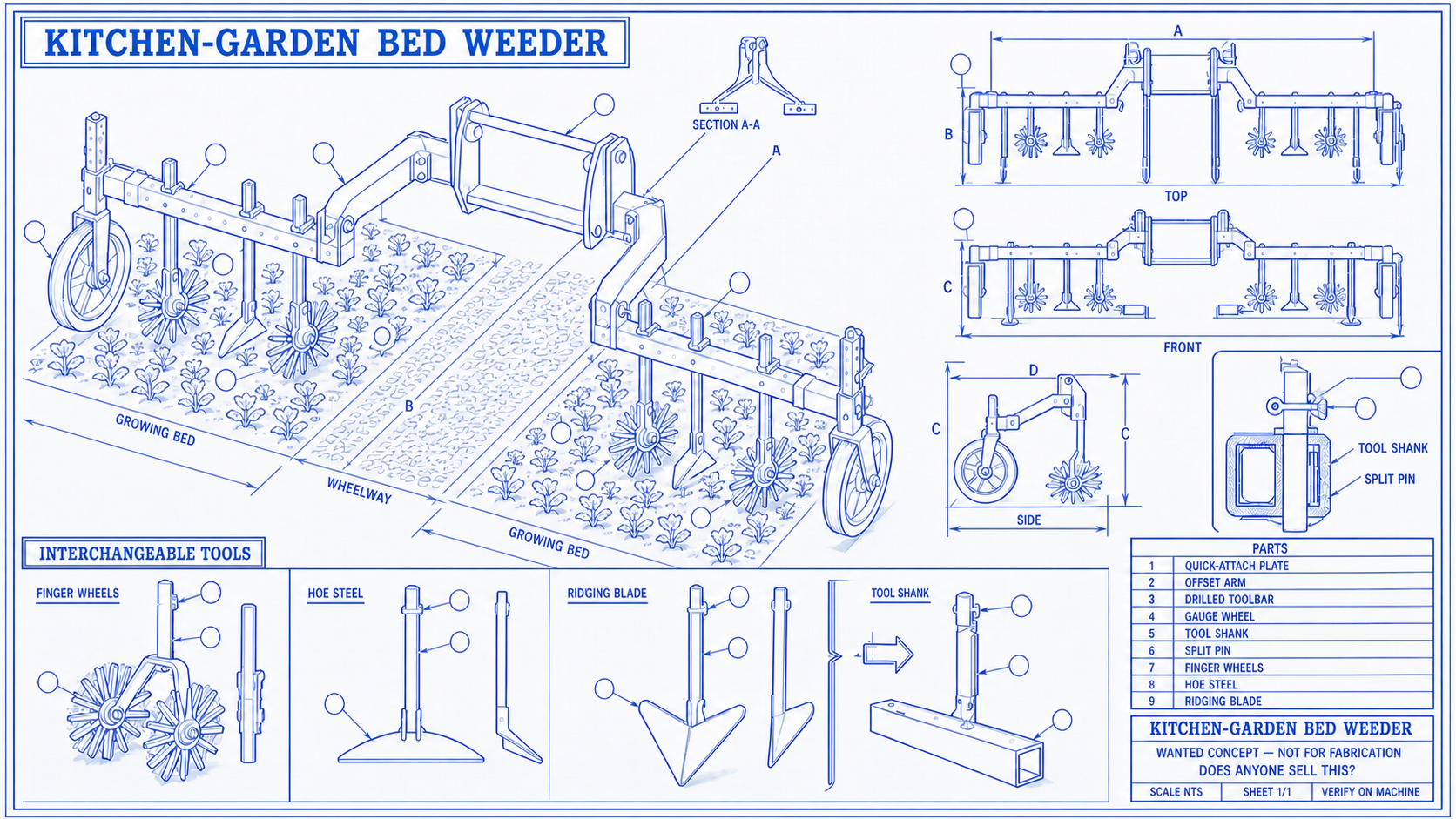
What it is
An offset weeding toolbar for the Avant quick-attach plate. The machine can’t drive over crops, so it drives a path with a bed on either side, and the tool reaches out sideways over the bed next to it — one arm to one side, or an arm each way taking both beds in a single pass. Each arm covers the bed width most serious kitchen gardens have settled on since Jean-Martin Fortier’s book: 75 cm, with 45 cm paths.
The bar itself should be nothing clever: a length of square box-section steel with a hole drilled through it every few centimetres. Every tool gets a shank that slides up through the bar and takes a split pin above, so it can’t drop out and nothing needs a clamp. Changing row spacing means pulling a pin and moving one hole over; swapping tools takes seconds. What goes under the bar is whatever the bed needs: finger wheels like the small K.U.L.T. Kress units (Ø 250 mm, made for 25–35 cm rows, working 2–4 cm deep), plain hoe steels, or a ridging blade. No hydraulics needed; the machine provides the forward motion.
Why I want it
My beds are at the standard 75 cm, and every one of them is weeded by hand today. Hand-hoeing is the job that loses to every other job on the property, and by July that shows in the beds. The machine already handles everything heavier here; weeding is the one recurring job where it just watches.
What exists instead
Avant’s catalogue has exactly one attachment with “weed” in the name: a rotating steel brush for paved surfaces. The soil tools, the rotary hoe and the rotary harrow, work the whole surface and would take the crop with the weeds.
One product proves a mini loader can do this job, just at the wrong scale: the Danish ScanMek MiniWeed, an inter-row cultivator built for mini loaders at 3.0 or 4.5 m working width and around 30,000 DKK. It names MultiOne, Schäffer and Giant; not Avant. That is a field tool for row crops, not something to steer around a kitchen garden.
Below that, the market jumps straight to tools you walk behind: wheel hoes like Terrateck’s, or the Tilmor Power Ox, a two-wheel tractor whose wide frame is built to straddle exactly this 30-inch bed. Good tools, and all of them mean walking every bed yourself. The closest existing bed-width implement I can find is the Treffler TINY tine harrow at 80 cm, designed to be pulled by a person.
What it would take
Less than most entries on this list. The bar is drilled box section, the pins are off the shelf, and the weeding elements are catalogue parts from the tractor-implement world. Side-mounted offset tools are a solved problem in vineyards and orchards, so the real design work is small: a quick-attach plate, an arm reaching roughly a bed centre to the side, and depth control, since the boom shouldn’t be what decides how deep a hoe runs — a gauge wheel at the end of each arm would do it. An arm on each side doubles the work rate and keeps the load symmetric.
The layout has to meet the machine halfway. A 528 is 1130 mm wide on standard grass tyres, more than twice the standard 45 cm path, so the garden needs a wheelway the machine fits — every second or third path made a track, with the standard paths in between untouched. That costs some growing area once; hand weeding costs hours every rotation. ScanMek’s pricing suggests where a product should land: their 3-metre field machine is about 30,000 DKK, and a one- or two-bed offset frame does not contain more steel than that.